Thursday, 9 May 2019

Up to the Mersey

Monday 22nd April
We left Nantwich on another warm and sunny morning, heading north towards Chester. The canal from here to the end, at Ellesmere Port, is built to broad dimensions so everything felt so much easier with wider bridges and of course larger locks.
This canal was originally part of the Ellesmere canal network built to link the limestone quarries, around Llangollen with the river Mersey. This required the building of a new port at the junction, which became Ellesmere Port.
I mentioned Telford's amazing skills, building the canal from Nantwich down to Birmingham,  he was involved with this earlier canal working with William Jessup who designed this canal.
William Jessup was one of the great canal builders, some of the greatest northern  canals were all down to him. He is somewhat overlooked due to his modesty.
We travelled up past the junction with what is now known as the Llangollen canal at Hurleston,  before passing the busy junction with the Middlewich branch at Barbridge, heading east to join the Trent and Mersey. Beyond here traffic reduced significantly as most boats turned right towards Middlewich.
We pressed on  with the busy A51 keeping us company for several miles.
Shortly after, we arrived at the old mill at Calveley and the large and very busy CRT service station before reaching some lovely Cheshire countryside.
We arrived at Bunbury locks, a double staircase, reminding us of the  locks on the Leeds Liverpool canal, We did a switch over here, there was a boat coming up the lock, so we entered the top chamber and the other boat entered the bottom. Once we had equalised the levels we opened the gates between the two chambers and swapped places with the other boat. They filled the top and we emptied the bottom camber before heading off in opposite directions.
Bunbury Locks
Pressing on through a wooded cutting with bluebells giving a misty blue hue around the base of the trees, we arrived at the next lock, this time a single chamber, passing through to the next two locks at Beeston. The top lock is known as Beeston Stone Lock for the simple reason it was built of stone rather than the usual brick hereabouts and the second is known as the Iron lock, again because this was built in the form of an iron tanks. The reason for the change to these two materials was due to the unstable nature of the ground, the area being surrounded by sandy hills.
Although the iron lock is built to broad dimensions, boaters are now advised to pass through one boat at a time, on our arrival we joined a queue of three boats down and three boats up, the lock filling and emptying is also very slow so an hour or so elapsed before we could make our way through.Most of the boats were heading home having taken advantage of the lovely Easter weather.
A mile or so further on we arrived at the last lock of the day, before dropping down to the moorings outside the Shady Oak pub, a remote establishment with a caravan site alongside.
This whole area is dominated by the impressive Beeston Castle, sitting on top of a huge sandstone outcrop some 350 feet above the surrounding countryside.
Beeston Castle
The castle is now looked after by English Heritage, we walked up to have a closer look but were too late to be able to climb up to the top. We walked right around the outcrop before returning to the pub and boat.
The castle is in ruins, another one destroyed by the Parliamentarians after the civil war. The Royalists survived a siege from November 1644 to November 1645 when they finally succumbed due to lack of food, the Cromwellian forces then partially destroyed the fortress, ensuring it could no longer be used as a stronghold.
Behind the hill and castle lay the pretty wooded slopes of the Peckforton Hills, reminding us of central Germany.
This whole area was a pleasant surprise to us as we were expecting flat fields as we approached Chester.
The top of the five locks dropping into Chester
Note the typical round "lock keepers"hut found along this stretch
The following morning we cruised on down to Chester passing through the five locks before arriving in the city centre, to our relief we found there was plenty of mooring space available on the moorings by the Lock Keeper pub. The walk into town from here was only a couple of minutes.
We stayed here for a couple of days enjoying some of the many attractions Chester has to offer.
On the second day we decided to relocate to the basin at the bottom of triple staircase locks, this meant a trip through an impressive cutting along side the City walls, passing the KIng Charles II tower where he reputedly watched his army being defeated by the Parliamentarians.
King Charles's Tower
A little further on we passed under Chesters own version of the Bridge of Sighs, an old bridge accessing the city gaol.
Chester's Bridge of Sighs
We battled through the difficult locks in  a torrential rainstorm, before arriving in the large basin below, there are plenty of moorings here along with all boater facilities, however, boaters please note, the refuse disposal is at the top of the locks.
Chester 3 lock staircase, the middle chamber is carved from solid rock
The basin contains the link down to the river Dee with the five locks linking the basin and river. This made Chester an important location until the development of the Mersey ports took most of the trade. The link fell into decline but has recently been renovated, the final lock onto the tidal river being the missing piece of the jigsaw. This lock, sady is still in a state of dereliction.
  
The basin at Chester
The lock from the basin onto the Dee linkxb64w hkcf 

The link onto the river Dee


Chester town center

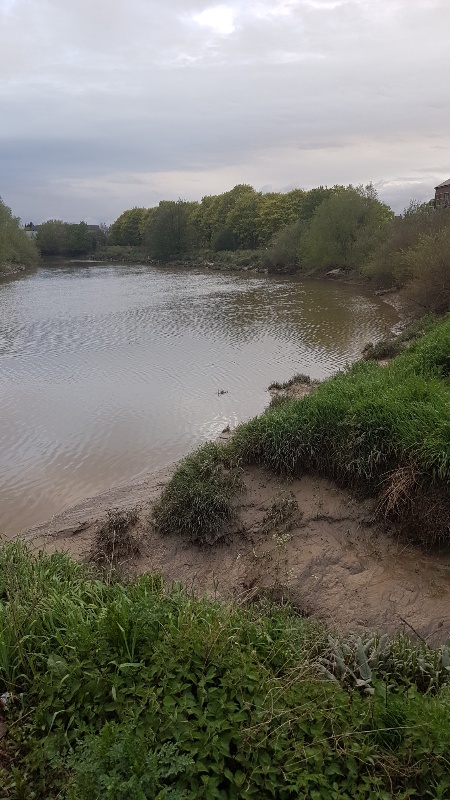
The Dee at Chester, a river we will be reunited with later

We made use of the Laundrette located just five minutes walk from the basin.
The following morning (Friday) our departure was delayed due to the canal being closed after the tragic discovery of a body a few hundred yards up from us, we were given the all clear before moving on to cross the Wirral.
This is quite a pleasant stretch of the canal passing close by Chester Zoo before going under the very busy M56. From here the view becomes somewhat more industrial with the large oil refinery at Stanlow. Crossing under the M53 we noted the site of the now demolished Wolverhampton Corrugated Iron works, they must of been huge as the works quayside stretch for almost a mile.
We arrived a Ellesmere Port and moored outside the Waterways Museum, there are moorings in the lower basin of the port but as it was raining we decided to stay at the top.
Before the arrival of the canal there was only the small village of Whitby in the location, however once the construction of the port and its link to the Mersey was completed the whole area developed into the town of Ellesmere Port now known for its connection with car production at the site of the Vauxhall works.
The museum is definitely worth visiting with many interesting exhibits  and interactive displays more information can be obtained on their website.
After the completion of the canal in mid 1790's the area was further enhanced by the construction of the Manchester ship canal in 1893, some very large ships now pass below the port.
We purchased our tickets for the museum and, as they are valid for 12 months, we visit several times during our stay here.
The lower basin of the museum with the storm clouds building in the distance
Looking out from the lower basin anto the Manchester Ship Canal
Tug on the Ship Canal
The weather took a turn for the worse so we had to sit out the teeming rain and howling gale for around 36 hours, before turning round and retracing our steps back to Chester.
Much improved weather with fine sunshine greeted our arrival at the bottom of the three rise locks, and the weather had brought out quite a number of visitors some of whom helped us up the locks.
Following a quick visit to the shops we pressed on up the five locks to moor up at the charming village of Christleton.
Canal scenes at Christleton
Monday morning brought more fine weather and we continued our journey down to Hurleston and the right turn onto the Llangollen canal arriving just in time to pass through the four locks at the junction.


Sunday, 21 April 2019

The Shropshire Union

Thursday 11th April
We awoke to a fine sunny morning although there had been a hard frost overnight.
Just as we were preparing to get underway a boat appeared and started down the locks in front of us, this meant we had to reset each lock as we descended the flight. Oddly enough I was relieved about this as the last time we came up the 21 locks there were problems with low water in some of the pounds so the boat in front would need to deal with any of these before we got there.

A cold and frosty start at the top of the Wolverhampton 21

Whilst in the first lock a lock keeper appeared from the cottage at the top of the flight, he set about sending water down the flight and ensured a smooth passage for us, and the few other boats coming up. We arrived at the bottom lock just over 4 hours after setting off.
The bottom of the 21, we turn right here on to the Worcs, Staffs canal

At the bottom we turned left heading up the short distance to the junction with the Shroppie at Autherley, here we had to negotiate the stop lock dropping us some 5 inches onto the new level.
The start of the Shropshire Union and stop lock at Autherley Junction

The Shroppie is a wonderful canal, built at the turn of the 19th century, by Thomas Telford. As with all of Telford's canals he preferred to  build his canals as straight as possible using cuttings, embankments, tunnels and compact lock flights rather than Brindley's approach of contouring requiring many twists and turns.
A few miles along brought us to the aqueduct carrying the canal over the busy A5, a road improved and built by Telford along the line of the roman road Watling Street.
Approaching Telford's Aqueduct of his improved A5

Looking down at the A5

Passing through the pretty village of Brewood we entered the first of the cuttings before emerging into beautiful scenery eventually reaching the single lock at Wheaton Aston.
The pretty village of Brewood

Avenue Bridge nr Brewood, built in a style to suit the local landowner.

We moored just below the lock as we were waiting for Streethay Wharf to come out the following morning to look at the stern gland as we had developed a significant leak over the last few days.
They arrived and made a few adjustments and we ran the prop for a while to see if all was ok, it appeared that the problem was solved and we got underway, calling for fuel at the town garage, they have a pump on the canal so we didn't have to sail onto the forecourt!
Cowley Tunnel hacked out of solid rock

We decided to head for the next village up, Gnosall Heath, a small settlement connecting the larger Gnosall village to the canal. Just before the village we passed under the short but impressive Cowley tunnel, carved out of solid rock. Further leaks occurred so another call to Streethay and they agreed to come out on Saturday afternoon to have another look. They reset the propshaft axial position (this had been adjusted following the work at Mercia Marina) and repacked the stern gland and again we ran the prop for a while and all seemed ok.
Tyrley wharf and the top lock of five

We decided to remain here overnight before setting off the following morning to the top of Tyrley locks, this stretch of the canal has some of the most spectacular features including the colossal Shelmore embankment, deep Grub Street and cavernous Woodseaves cuttings. It really is incredible that these features were all built on and carved out of the land using nothing more than hand tools and shear hard graft. Woodseaves cutting is, in some places, cut through solid rock with the canal being a stone tough, unsurprisingly it is quite narrow and shallow in some places. Progress was quite tricky when passing boats coming the other way, the displacement from the boats left us high and dry on a stone ledge on more than one occasion. The cutting has its own micro climate as the bottom rock faces rarely see sunlight so it is a haven for ferns and mosses.
The Iconic double arched bridge in Woodseaves cutting

Shortly after the cutting we arrived at the pretty wharf at the top of the locks, deciding to wait until the following morning before descending down to Market Drayton.
I was extremely pleased to see that after 6 hours of running the stern gland seems to be fixed although it will need to be monitored for a few days yet before I get my confidence back. It is a credit to Streethay that they came out twice to the boat and I can't thank them enough for their efforts.
We have heard bad reports about them but in our experience they cannot be faulted.
Monday morning brought more frost and bitterly cold winds as we made our way down the five locks of the Tyrley flight, the last two locks descend through another spectacular cutting again carved out of solid rock.
The last couple of locks at Tyrley cut through solid rock

On reaching the bottom it was only a mile or two before we arrived at the moorings in Market Drayton, it was fortunate that we arrived early as they  quickly filled up during the afternoon. There were a few historic working boats arriving, breaking their journey on the way up to the Easter Boat Gathering at Ellesmere Port at the end of this canal.
We had a walk into the town, now sadly looking a bit below the status it must have held at one time. There are plenty of  interesting old buildings some in need of restoration. We called at the Joules Brewery tap at the Red Lion, a large and pleasantly restored place. The brewery stands across the yard from the pub.
One of Telford's fine aqueducts at Market Drayton showing the scale of the works to build this canal

Tuesday morning brought, thankfully, slightly warmer weather so we decided to travel the couple of miles to the next flight of locks at Adderley, dropping down the locks we moored on the very pleasant moorings below the bottom lock. On this stretch we passed another of the Cadbury Wharfs again on this site they made the rough chocolate from the milk of the many dairy farms in this area, the chocolate was then transported by boat to Bournville for final processing. The last boat, skippered by "Chocolate Charlie", left here in 1968. There is still a huge plant here, managed by Premiere foods producing products such as Marvel dried milk.
Cadbury Wharf
Wednesday 17th April
The weather had improved significantly and, after a cold start the sun soon warmed things up, brightening up the pretty springtime scenery. It wasn't long before we arrived at the top of the 15 lock flight dropping us down to the Cheshire plain and the pretty village of Audlem, we have stopped here before and always enjoy our time here, this time even better catching up with old friends and a lovely meal in the Lord Combermere pub in the village centre, of course the other two pubs were also visited.

The top of the Audlem 15
A lock keepers cabin, unique to this canal


Looking down towards Audlem

The weather had now become hot more typical of a high summer's day so we took the opportunity, of not having a fire, to clean the chimney, always a mucky job but important it is done. Inspection of the engine bay also showed that the stern gland was holding up too.
Thursday, yet another fine day, brought us to Hack Green, a couple of miles and locks further north, we were debating whether to press on to Nantwich a little further on, but reports were coming back from boats travelling towards us that the moorings were full as it was the Jazz and Blues festival, so we tied up just above another two locks. The moorings here are a delight and plentiful. We decided to take the short walk down to the Secret Nuclear Bunker, a remnant of the cold war that had been turned into a museum. It is quite interesting with displays of nuclear weapons as well as a recreation of the facilities provided by the bunker in the event of  nuclear war. On Saturday we decided to take advantage of the fine weather and get some of the scratches in the paint work patched up.

Hack Green


The radar at Hack Green Bunker

Sunday (Easter) we moved on yet another short cruise up to Nantwich. Thankfully we managed to find space on the moorings, yet another fine day so we decided to walk into the town,The festival was in full swing with crowds in every pub and, most pubs were serving bbq food as well, making for a very enjoyable afternoon.

The Aqueduct at Nantwich

The impressive embankment at Nantwich with boats moored above the town.
Natwich


Nantwich marks the end of Telfords efforts, as it is here his canal reached the broad canal linking the town with the Mersey and Manchester Ship Canal at Ellesmere Port. His design and construction efforts were still not over however as his plan to join his canal with the end of the older northern section were thwarted by a local landowner who refused to have the canal cross his property. This required Telford to build yet another huge embankment and aqueduct as the canal skirts the town before finally reaching the existing route north.
We will head on up to Chester and Ellesmere Port before retracing our steps back to the junction at Hurleston and the Llangollen canal.

some of the beautiful countryside with the Long Mynd hill just showing in the haze


Historic boat and Butty passing at Adderley


Local dairy herd taking a drink, not sure how this will affect the milk!


Wednesday, 10 April 2019

Underway again..ish


Our last few days in the marina were spent having the boat serviced and with me going off for the annual weekend with my old rugby mates, on my return we had a visit from our old friends Paul and Steph, from Leeds.
Monday morning arrived and we readied ourselves for departure, we were soon underway making our way west on the Trent and Mersey heading for one of our favourite mooring places at Alrewas.
The weather was gorgeous, a lovely sunny spring day, Lucia managed to do all the locks despite nursing a heavy cold, the first (cold) since we left Leeds almost two years ago.
We overnighted in Alrewas and restocked the medicine cabinet with cold remedies from the pharmacy there before setting off in more spring sunshine. We were headed for Streethay Wharf to get repairs done that were identified during the service, requiring a left turn onto the Coventry Canal at Fradley junction.
The repairs required the boat to be pulled from the water and very quickly we saw the first of the problems, this was a worn key that provides the drive from the propshaft to the propeller, on removal it was discovered that the key was severely worn, fortunately it was a brass key making this a sacrificial part whilst protecting the shaft and propeller. This was soon remedied and the engineers moved on to the next jobs, firstly the installation of a hatch giving access to the fuel tank as we had developed a bad case of diesel bug necessitating the tank to be cleaned thoroughly.
Diesel bug is an algae that grows between water and bio diesel, it is foul stuff, a thick black  jelly that can cause severe damage to the engine if left to get out of control.
The second job was the replacement of the cup that supports the bottom of the tiller stock. Ours is a Liverpool boat and the tiller assembly is a poor design requiring significant work to dismantle it to carry out any necessary work.
The boat was out of the water overnight and we had the unusual experience of spending the night on the boat with out any of the usual movement experienced in the water.
The following morning work commenced and by lunchtime we were afloat again ready for departure.
We cruised the short distance along the Coventry canal to Whittington before setting the next morning in more fine weather heading for the Birmingham and Fazeley canal. We made the right turn at Fazeley junction managing not to knock the chimney off under the low bridge. We cruised to the bottom of Curdworth locks to the moorings we had stayed on in May last year. We took the opportunity to revisit the lovely Middleton Hall before walking across the fields past the training grounds of Aston Villa FC.
Drayton Footbridge, each tower contains a spiral staircase up to the bridge

The next morning, Saturday, we started to climb the eleven lock flight, and it was here that I noticed vibration on the tiller arm, further inspection showed that the two bolts that hold the tiller bearing had failed again. After much discussion with the boatyard it was agreed that the only option was to turn around and return to the boatyard, this required us to complete the lock flight before turning and descending again. We finally returned to the bottom of the flight and moored up ready for the long trip back to Streethay on Sunday.
By this time I had also succumbed to the dreaded lurgy, but a steady days cruise got us back ready for a lift out on Monday morning.
Much discussion ensued and it was agreed that the the whole tiller assembly would have to be removed for the rudder to be shortened and a new plate and bolts to be installed.
All work completed we returned to the water and got underway the following morning, unfortunately the fine weather had deserted us and we set off in cold and rainy weather. We retraced our steps to Curdworth locks, ascending the first three to moor outside the Dog and Doublet, visiting for a delicious tea consisting of an enormous Steak and Kidney pudding.
The following morning was drier whilst still cold and we made our way up the remaining 8 locks and up the 3 at Minworth before reaching Star City moorings for the night.
Our route took us close to the centre of Birmingham along the Satltey Cut, built to avoid the 25 lock climb into the centre, we had the 5 locks of the Garrison flight to negotiate along this stretch before reaching the junction at Bordesley where we joined the Grand Union.
Turning left we were straight into the 6 locks of the Camp Hill flight. This whole stretch is very industrial and on a couple of occasions I could here what I thought was the sound of heavy industry, only to find they were scrap recycling plants, very little seemed to be going on in the innumerable factory buildings around us.
Following the locks at we set off along the Grand Union in a bitterly cold wind and rain at first all seemed ok but as we reached the outskirts of the city the canal descended into a wooded cutting and became very shallow making steering difficult and progress very slow. We also had a rope and old fender wrapped around the prop requiring 30 minutes of cold hacking and carving to free it.
Finally arriving at Catherine De Barnes, the first advisable mooring from the city, we tied up and retired to the inside of the boat to dry out and warm up. The rain finally stopped and I took a stroll into the village, that had very little to offer.
Next morning the going was a little easier and it was dry so we made our way through the five large double locks at Knowle and down to Kingswood junction to cross over to the Stratford Canal.
Kingswood Junction
The first of nineteen at Lapworth

Here we turned right heading north back towards Birmingham, this required a climb up the top 19 locks of the Lapworth flight.
The scenery around here was sublime with rolling fields and some very impressive properties.
We made good progress and were joined by a lock keeper part way up, making for an easier passage.
Arriving at Hockley Heath we tied up for a couple of nights.
Vicky and Ian joined us on the Saturday, and we had a good lunch at the Wharf Tavern.
Sunday morning  brought good weather and we made our way along another shallow stretch filled with logs and shrubs. We finally reached the old stop lock on the approach to Kings Norton junction where we turned right  onto the Birmingham and Worcester canal heading for the city centre.
Brandwood tunnel on the North Stratford


The old stop lock near Kings Norton Junction with its Guillotine gates

The view from the impressive aqueduct at Edgbaston on the way into the city

We did this stretch last year so carried on past the impressive Cadbury factory soon arriving at Gas Street, mooring alongside the Arena.
Farmers Locks
We took a walk down the Farmers flight of locks dropping straight down from the Old Turn junction, we have not boated this flight so walked down to the bottom to explore on foot, it is an amazing place with 200 year old locks surrounded by modern office and apartment blocks.
We stayed in the city for three nights and on Tuesday we were visited by Indi and his wife Giann. I worked with Indi on contract in Wales some 15 years ago, so we had a great catch up, over a good lunch, in the Tap and Spile.
Indi and Giann

Later that day we met up with Tore and Kirsten whom we met last year and had a good evening comparing notes from last years travels.
Wednesday was a fine day if rather cold for the time of year so we cast off making our way along the new and old lines to Wolverhampton where we are now moored ready to descend the 21 locks down to the Worcestershire  and Staffordshire canal where we turn right a the short distance to turn left onto Shropshire Union and our journey north.
Leaving Birmingham
The M5 crossing, the lower bridge is the old line canal 3 locks higher than the new line


Ascending the three locks upto the old line (Wolverhampton) level

Springtime on the waterway


Moving On

After a few indifferent days weather-wise things started to improve although there was still a risk NE wind. We decided to walk down to Rest...